
Why Is Sciatica Worse When Sitting or Driving?
Why Is Sciatica Worse When Sitting or Driving?
For many people with sciatica, sitting is one of the hardest things to do.
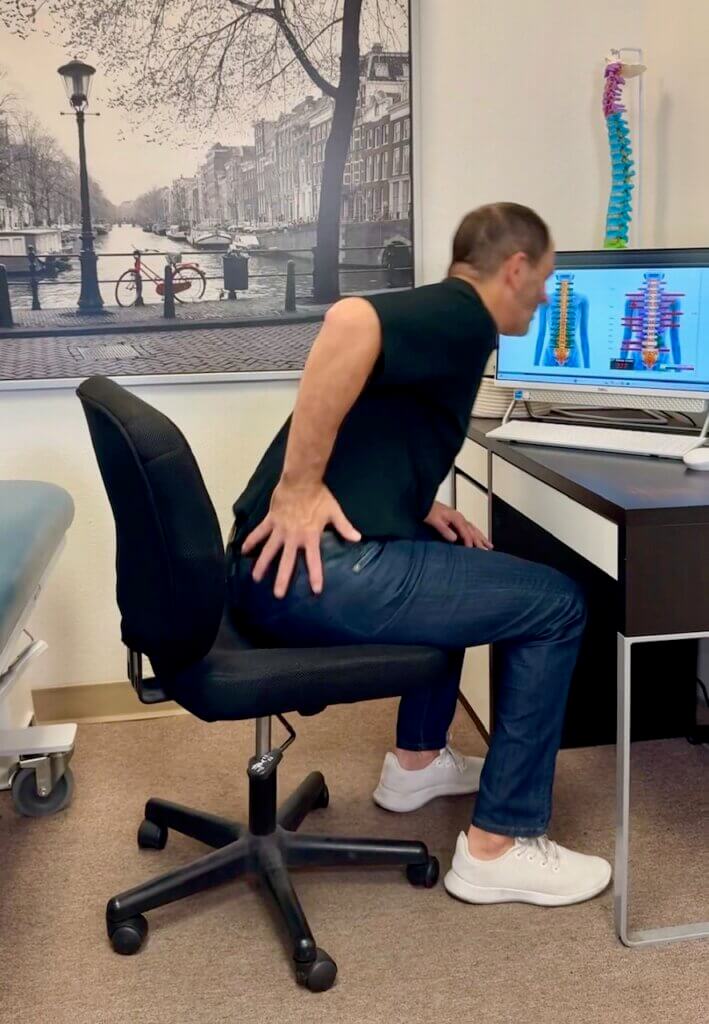
That can be especially frustrating because so much of daily life involves sitting. You may feel okay walking around and talking with coworkers, but after 20 or 30 minutes at your desk, the pain starts building. You begin shifting around trying to find a comfortable position, and eventually it becomes hard to focus on anything except your leg.
Or maybe driving is the problem.
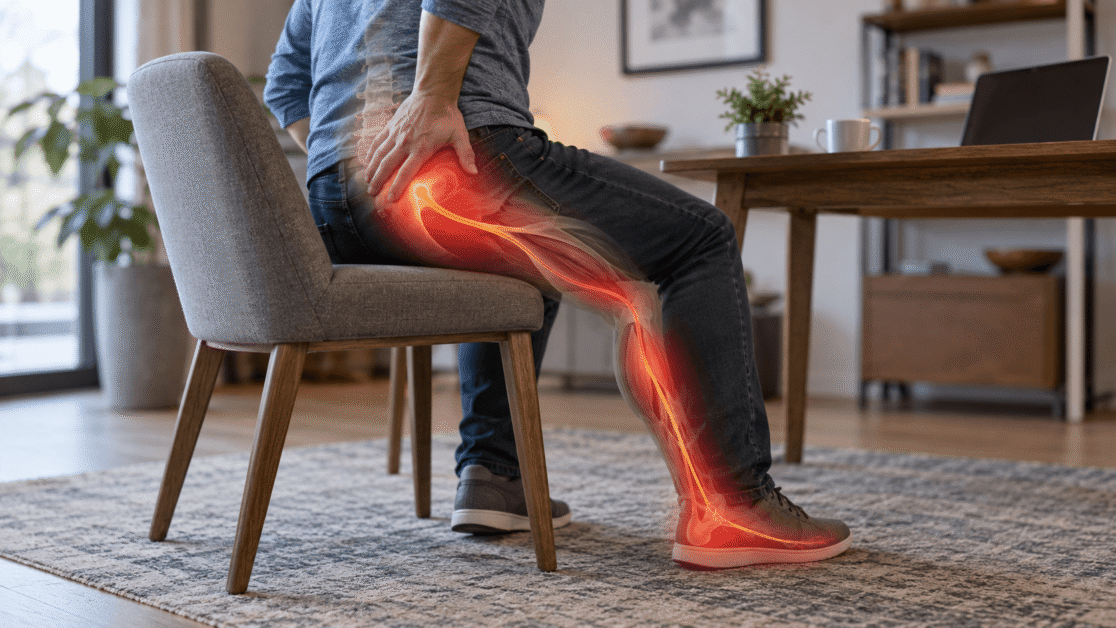
You get into the car feeling fine, but by the time you arrive at work—or finish a longer drive—you have pain, burning, tingling or numbness traveling into your buttock or leg.
Then you get home and just want to relax on the couch and watch TV, but as soon as you sit down, the pain starts again.
So why is sciatica worse when sitting or driving?
The answer depends on what is causing your sciatica, but sitting changes the mechanical load on the lower back and may aggravate an already irritated lumbar disc or nerve root.
The way your symptoms respond to sitting, standing and movement can also give us useful clues about what may be contributing to the problem.
Why Can Sitting Make Sciatica Feel Worse?
Sitting puts your lower back and pelvis in a different position than standing.
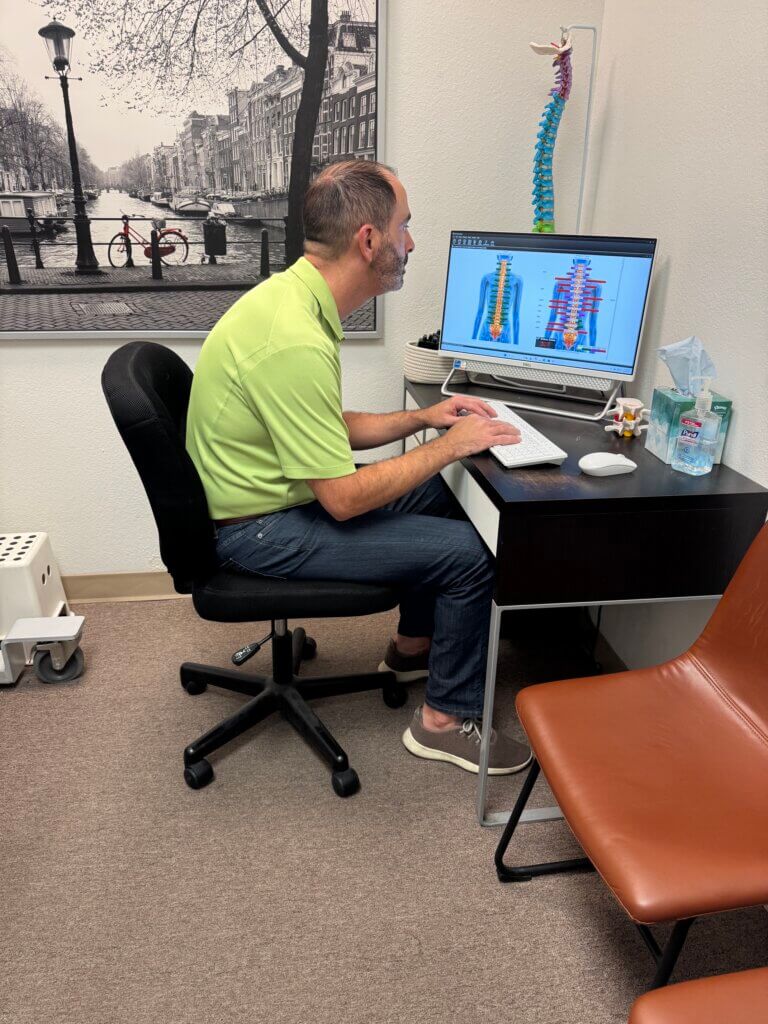
The amount of stress placed through the lumbar spine can vary depending on your posture, chair, hip position and the underlying cause of your symptoms.
If a nerve root is already irritated, even normal mechanical stress may become uncomfortable.
That is why some patients tell us:
“Standing and walking are okay. But sitting kills me.”
That pattern does not diagnose the problem by itself, but it gives us useful information about how the symptoms respond to different positions.
A Disc Problem May Be Part of the Picture
One common reason sitting aggravates sciatica is disc-related irritation.
The discs between the vertebrae act as shock absorbers and help distribute forces through the spine.
When you sit—especially when you slump or round through the lower back—the mechanical forces on the lumbar discs change.

If a disc is already irritated, bulging or herniated near a nerve root, that position may increase symptoms for some patients.
You may notice:
- pain in the buttock
- burning into the thigh
- tingling down the leg
- numbness in the foot
- a pulling sensation behind the hamstring
- worsening leg pain the longer you sit
The important point is:
Your leg may hurt even though the irritation is originating in your lower spine.
Think of it like throwing a pebble into a pond. The irritation may begin in the lower back, but the symptoms can ripple farther down the nerve into the leg.
Why Can Driving Be Even Worse Than Sitting?
Driving adds several factors at the same time.
You are sitting, your hips and knees remain flexed, you may be slightly rotated or shifted while operating the pedals, and you are exposed to vibration from the road.
Put those factors together and an already irritated nerve may become uncomfortable fairly quickly.
We often hear:
“I can sit in my recliner, but I can’t sit in the car.”
Or:
“I feel okay when I get in, but after 30 minutes my leg starts burning.”
That difference matters.
It tells us that not every sitting position affects the patient the same way.
Your Sitting Position Matters
Small changes in position can sometimes reduce unnecessary aggravation.
Sitting too far from the steering wheel may cause you to reach with your legs and change the position of your lower back. Sitting very low can also change your hip and pelvic position.
A wallet, phone or another bulky object in the back pocket may create additional asymmetry under the pelvis.
At a desk or in the car, posture can also gradually change as you become tired. The pelvis rolls backward, the lower back rounds and you sink deeper into the chair.
This does not mean there is one “perfect posture” that everyone has to maintain all day.
Changing positions regularly may be more helpful than trying to hold one supposedly perfect position for hours.
Why Does Standing Up Sometimes Help?
Some patients tell us:
“If I stand up and walk around for a few minutes, it feels better.”
Standing changes the position of the pelvis and lumbar spine, while walking introduces movement through the hips, pelvis and lower back.
For some patients, those changes calm the symptoms.
When pain consistently changes with position or movement, that gives us useful information during the examination. It may suggest that mechanical factors are influencing the symptoms and helps us decide whether conservative care may be appropriate.
Sitting Does Not Make Every Type of Sciatica Worse
This is an important distinction.
Some patients feel worse sitting.
Others do not.
For example, some people with spinal stenosis may actually feel better while sitting or leaning forward and worse while standing or walking for longer periods.
That is one reason we cannot assume every patient with pain traveling into the leg has the same problem.
One patient may tell us:
“Sitting is terrible, but walking helps.”
Another may say:
“Sitting feels fine, but I can’t walk through the grocery store without my leg starting to hurt.”
Those are different patterns, and they may point toward different underlying causes.
Long Periods of Sitting Can Also Create Muscle Tightness
Sitting in one position for a long time can also cause muscles around the hips, buttocks and lower back to become stiff or guarded.
If you are trying to avoid pain, you may start leaning to one side, shifting your weight or changing the way you move without realizing it.
But the tight muscle is not always the primary problem.
Sometimes muscle tightness is part of the body’s response to an underlying joint, disc or nerve problem.
That is why simply treating the tight area may not address everything contributing to the symptoms.
What Can You Do If Sitting Aggravates Your Sciatica?
The first thing is simple:
Do not remain in one position for hours if that position is steadily increasing your nerve symptoms.
When possible:
- stand up periodically
- take short walking breaks
- change positions
- adjust your desk chair or car seat
- avoid bulky objects in your back pocket
- use lumbar support if it feels comfortable
- avoid repeatedly sitting through increasing pain just to “tough it out”
For longer drives, taking periodic breaks to get out of the car and walk for a few minutes may help.
At work, even short movement breaks throughout the day can be useful.
The goal is not necessarily to avoid sitting altogether.
It is to reduce prolonged exposure to a position that repeatedly aggravates your symptoms.
Be Careful About Stretching an Irritated Nerve
People often assume:
“My leg feels tight, so I need to stretch it harder.”
But nerve-related symptoms do not always behave like a tight muscle.
Aggressive hamstring stretching may sometimes place additional tension along an already irritated nerve.
That does not mean stretching is always inappropriate.
It means the right exercise depends on why you are having the symptoms in the first place.
If a movement repeatedly increases burning, tingling or pain farther down the leg, it may not be something to keep forcing.
Your Symptom Pattern Gives Us Clues
At Desert Valley Chiropractic, some of the questions we pay attention to include:
- How long can you sit before symptoms begin?
- Is driving worse than sitting in a regular chair?
- Does standing or walking improve the pain?
- Does the pain travel farther down the leg the longer you sit?
- Do you have numbness, tingling or weakness?
No single answer makes a diagnosis.
But together, those answers can begin to form a useful clinical picture.
How Our Sciatica Freedom Protocol Approaches Sitting-Related Pain
This is one of the reasons we developed our Sciatica Freedom Protocol around more than one treatment tool.
When someone has recurring sciatica that becomes significantly worse with sitting or driving, we want to understand the mechanical components involved rather than simply treating the location of the pain.
Depending on the examination and clinical findings, care may include:
Gentle Activator Method Adjustments
Both Dr. Katherine Iacuone and Dr. David Iacuone are advanced certified in the Activator Method.
The Activator allows us to deliver precise, low-force chiropractic adjustments without traditional twisting, cracking or popping. It also will reduce swelling around the facet joint and the nerve root.
For someone with sciatic symptoms, we may evaluate movement through the lumbar spine, pelvis and related joints to determine where altered mechanics may be contributing.
Lumbar Spinal Decompression
When disc or nerve-root irritation appears to be contributing, lumbar decompression may also be considered.
Decompression applies controlled traction through the lumbar spine and may be used alongside chiropractic care for appropriate patients.
It is not automatically the right treatment for everyone with sciatica. The examination helps us determine whether it belongs in the treatment plan.
Soft-Tissue and Movement Support
Long periods of guarding and altered movement can also create muscle tension and compensation.
We do not use shockwave therapy for every sciatica patient, and we rarely begin there. But if joint motion is improving while persistent muscle guarding continues to limit progress, we may discuss layering in shockwave therapy or other supportive care.
We are not simply treating the pain you feel while sitting. We are trying to understand why sitting triggers the symptoms in the first place.
A Recent Patient Example: Gentle Care After Previous Low-Back Surgery
A recent patient came to us with a history of previous low-back surgery.
Years earlier, he had undergone an L5 laminectomy/decompression and had done very well for a long time.
Eventually, though, the pain came back.
Because of his surgical history and the way his symptoms were presenting, we referred him for a new MRI. The MRI demonstrated a new disc herniation at L4, which was consistent with the location and behavior of his symptoms.
Sitting at work had become difficult, and driving was especially challenging.
He had several family road trips coming up and was worried about whether he would be able to tolerate being in the car for that long.
Because he had already undergone lumbar surgery, we were especially thoughtful about keeping his chiropractic care gentle, specific and tailored to his current findings.
Rather than using traditional twisting or forceful manual adjustments, we used the Activator Method, which allows us to deliver a precise, low-force adjustment without twisting, cracking or popping the spine.
We then built the rest of his care around the new L4 disc herniation and his current clinical presentation.
He completed our Sciatica Freedom Protocol, individualized to his specific needs.
By the end of the protocol, his low-back pain had become minimal, he was once again able to sit comfortably for work, and he recently returned from a six-hour family road trip with no pain.
His case is a good example of why we do not treat every episode of sciatica the same way.
A previous surgery, an old diagnosis or an older MRI does not necessarily explain a patient’s current symptoms. Sometimes the problem changes, and the treatment plan needs to change with it.
For this patient, identifying the new L4 disc herniation and using a gentle, individualized approach helped him get back to sitting comfortably, working and traveling with his family.
Looking for Sciatica Treatment in Phoenix?
If sitting through work, driving across Phoenix or even relaxing at home is becoming difficult because of sciatic pain, it may be time to look more closely at what is triggering the irritation.
At Desert Valley Chiropractic, we evaluate the pattern rather than simply treating where the pain happens to show up.
Our Sciatica Freedom Protocol may include:
- gentle Activator Method chiropractic adjustments
- lumbar spinal decompression
- supportive soft-tissue therapies such as shockwave when appropriate
- rehabilitation and movement recommendations
Both Dr. Katherine Iacuone and Dr. David Iacuone are advanced certified in the Activator Method and were recognized on PHOENIX magazine’s 2026 Top Chiropractors list.
No traditional twisting, cracking or popping—and no assumption that every patient with sciatica should receive exactly the same treatment.
If sitting or driving consistently causes pain to travel into your buttock or leg, contact Desert Valley Chiropractic in Phoenix to schedule an evaluation.


