
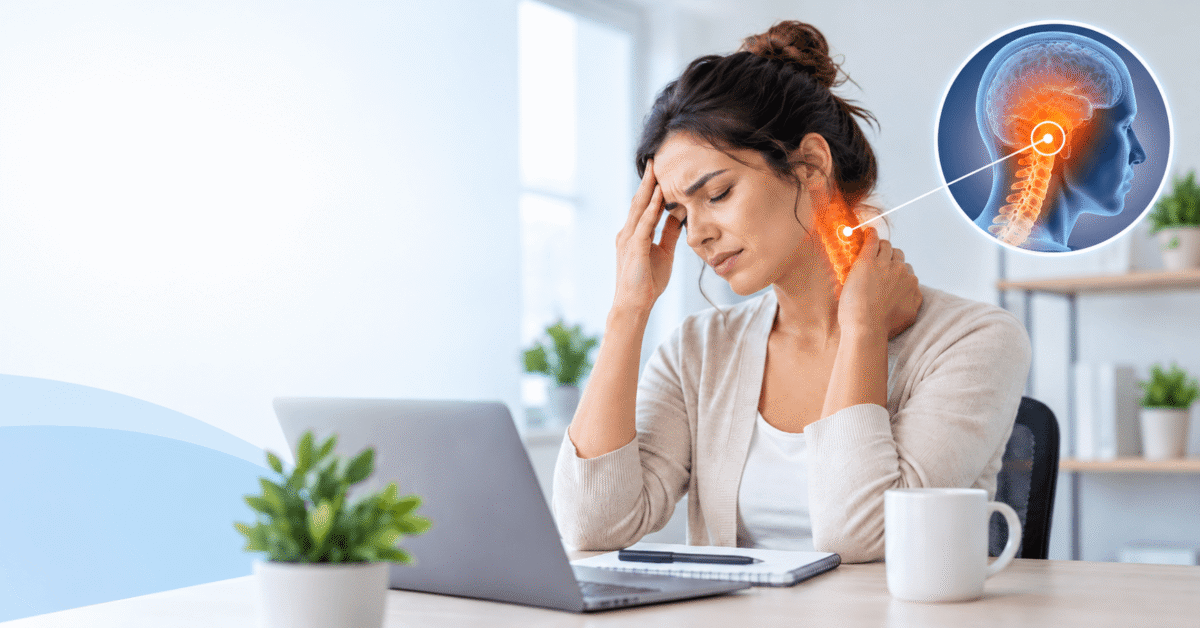
Can Neck Problems Cause Headaches? What You Should Know
Can Neck Problems Cause Headaches? What You Should Know
If you regularly experience neck pain and headaches at the same time, you may have wondered:
Can my neck actually be causing my headaches?
In some cases, yes.
Certain headaches can originate from structures in the cervical spine and be felt in the head. This is known as referred pain, meaning the source of the pain is in one area of the body while the symptoms are felt somewhere else. Cervicogenic headache is one example.
During our initial conversation, patients often tell us things like “My headache always seems to start in my neck.” Or “I can feel my shoulders getting tight at work and then the headache starts.”
Once the physical exam is complete its usually clear that headaches are coming from a patients neck, and other times, it isn’t.
While it is true that many headaches are related to neck pain, not all of them are and that distinction is important.
Different types of headaches require different approaches.
What Is a Cervicogenic Headache?
A cervicogenic headache is a secondary headache and literally means a headache that starts in the neck.
The pain may come from one or more structures such as the cervical joints, discs, ligaments, nerve roots or surrounding soft tissues.
Because the nervous system can perceive pain away from the actual source, a problem in the upper cervical spine may be felt as pain:
- at the base of the skull
- on one side of the head
- behind the eye
- toward the temple or forehead
- along the back of the head
This is why treating only the location of the headache may not always address the full problem.
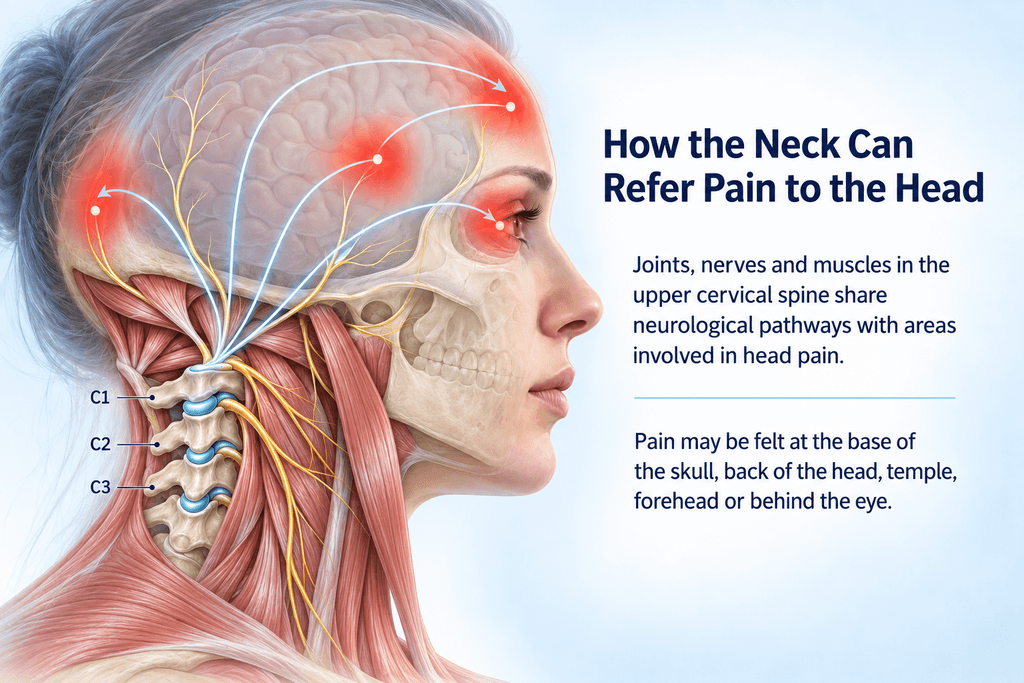
As an example, something I have seen regularly over the last 23 years, when a patient has headache behind one eye, C2 or the second cervical vertebrae on the same may be involved. The top of the neck can be tender to touch and sometimes painful to turn their head.
I once had a patient describe it as being shot with an arrow from the back of the neck through to the back of the eye. Ouch!
What Does a Neck-Related Headache Feel Like?
Cervicogenic headaches often have certain patterns.
You may notice: (use info graphic)
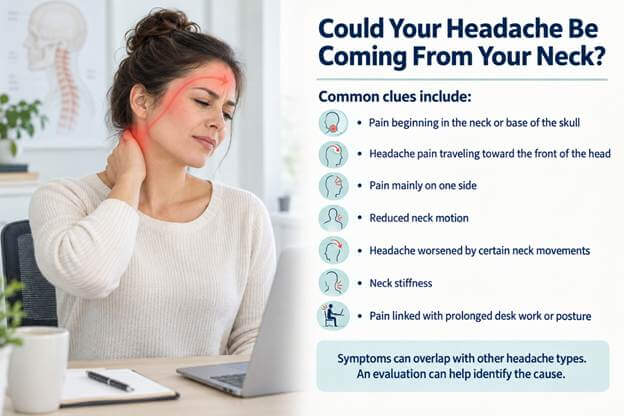
- pain beginning in the neck or base of the skull
- headache pain that travels toward the front of the head
- pain mainly on one side
- reduced neck motion
- headache that worsens with certain neck movements
- neck stiffness
- pain associated with prolonged desk work or posture
Cleveland Clinic notes that cervicogenic headaches often involve one-sided head pain and limited neck range of motion, and symptoms may worsen with neck movement.
But this may not be the whole picture because these symptoms can overlap with migraine and other headache types.
That is why we do not want to assume:
“My neck hurts, so this must be a cervicogenic headache.”
Migraine, tension-type headaches and other conditions can also include neck pain or tightness.
Why Can the Neck Cause Pain in the Head?
The upper cervical spine contains joints, nerves, muscles and other tissues that share neurological connections with areas involved in head pain. ( insert diagram)
When one of those structures becomes irritated, the brain may interpret the signal as pain in the head rather than only in the neck.
Think of it like an issue in the fuse box at your home.
The problem may begin in one location (the fuse box), but the signal or problem can be perceived somewhere else along the system.
This is why someone can have a headache behind the eye even though the irritated structure may be in the upper neck.
Joint Dysfunction Can Be Part of the Picture
We have 7 bones in the cervical spine, and they are designed to move.
When certain joints are not moving normally—or when movement becomes painful—the surrounding tissues may begin compensating.
At Desert Valley Chiropractic many of our headache patients experience restricted or irritated joints in their neck. That is why it’s critical we evaluate:
- cervical range of motion
- areas of restricted movement
- neurological findings
- posture and movement patterns
- symptom behavior
- previous injuries
- headache location and timing
It is not always cut and dry, so we have to look for a pattern rather than simply asking where the headache hurts.
Tight Shoulders and Trigger Points Can Contribute Too
Far too many patients struggle with chronically tight shoulders and upper trapezius muscles.
We often hear patients say:
“I stretch my neck and shoulders constantly.”
“Massage helps, but the tightness always comes back.”
“By the end of the workday my shoulders are up around my ears.”
While it’s true that muscle tension and trigger points in the neck and shoulders can contribute to pain patterns that extend toward the head. Sometimes those muscles are the primary problem and sometimes they’re not.
Massage can be super helpful, but if you are regularly getting massage and the tightness and pain keeps coming back, then an underlying structural or spinal problem may be the reason the area keeps tightening.
Desk Work Can Create the Perfect Storm
It probably won’t come as a surprise but roughly 86% of Americans spend some time sitting a desk for work and according to the US bureau of labor and statistics, they spend 66% to 82% of their day at their desks.
Many of us start the day fresh, sitting nice and straight, but as the day goes on, posture often gradually changes.
The head moves forward.
The shoulders round.
The upper back arches and stiffens.
The muscles at the base of the skull and across the shoulders work harder to support the head.
You feel relatively good in the morning and then notice the familiar pattern developing by afternoon:
tight shoulders → stiff neck → headache
This doesn’t mean posture alone is always causing the headache.
But prolonged static positions can certainly contribute to mechanical stress in the neck.
Just as we discussed with sitting and sciatica, changing positions throughout the day may matter more than trying to maintain one “perfect” posture for eight hours.
Could a Cervical Disc Be Involved?
In some patients, cervical disc irritation may also be part of the picture.
A bulging or herniated disc can irritate nearby structures or nerve roots. This can lead a neck that locks up creating tension that can cause a headache.
When that happens, neck pain may occur along with symptoms such as:
- pain into the shoulder or arm
- tingling
- numbness
- weakness
- pain that changes with neck position
A cervical disc problem may not be the most common cause of headaches, but it does happen.
Can Neck Problems Cause Headaches – A Patient Experience
Last year we had a patient with two herniated discs in her neck. The left sided neck pain it caused was severe. She was severely limited in how far she could move her head and neck without causing excruciating pain that would shoot down her arm. The muscles in her neck were in spasm which referred up to the back of the head creating intense left side headaches. She oversaw nurses at a local hospital and while the neck pain would have been enough the combination if neck pain and headaches made it incredibly difficult to focus at work.
It was a complicated case and her recovery took 3 months but with treatment that included gentle chiropractic care and cervical decompression the nerve impingement reduced, the pain down her arm reduced and the spams subsided. With that the headaches coming indirectly from the herniated discs in her neck went away.
Headaches and Neck Pain After a Car Accident
A car accident is another situation where neck pain and headaches commonly appear together. Over 60% of people injured in a car accident suffer with headaches
Sudden acceleration and deceleration can place significant stress on the cervical joints, muscles, ligaments and discs.
A patient may initially notice stiffness or soreness and then develop headaches over the following hours or days.
Mayo Clinic lists whiplash and other cervical injuries among conditions that may be associated with cervicogenic headache.
If headaches begin after a collision or other injury, the history matters.
We want to know:
- Did the headaches exist before the accident? If so did they change?
- When did they start?
- Where are they located?
- Did neck pain begin at the same time?
- Is neck motion limited?
- Are there neurological symptoms?
Those details help determine whether further evaluation or imaging may be appropriate.
How the Neck Pain & Headache Relief Blueprint Approaches the Problem
This is the idea behind our Neck Pain and Headache Relief Blueprint at Desert Valley Chiropractic.
We do not assume every patient needs the same treatment.
Instead, we evaluate the mechanical components involved and use different tools for different problems.
Gentle Activator Method Chiropractic
Both Dr. Katherine Iacuone and Dr. David Iacuone are advanced certified in the Activator Method.
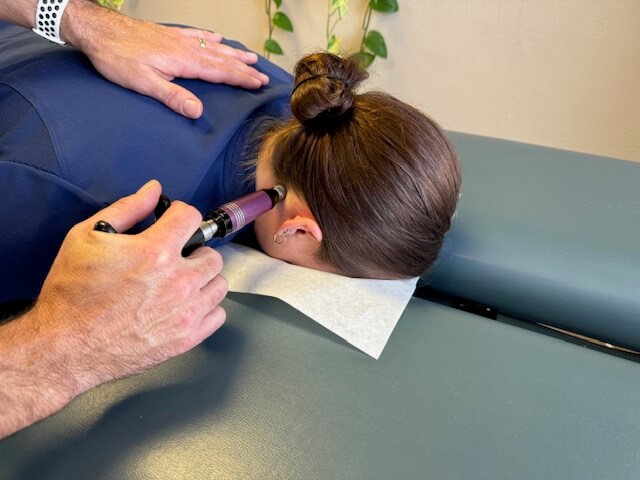
The Activator allows us to deliver precise, low-force chiropractic adjustments without traditional twisting, cracking or popping.
For patients with neck pain and headaches, we may evaluate cervical joint movement and use gentle adjustments when restricted joint mechanics appear to be contributing.
Shockwave Therapy for Persistent Soft-Tissue Tightness
This is particularly helpful for those patients who continue to experience stubborn trigger points or muscular guarding even after joint motion begins improving.
We do not use shockwave automatically for every headache patient, but if someone does not respond as expected to chiropractic care then we may layer in shockwave therapy to address persistent soft-tissue tension and trigger-point regions in the shoulders and upper back.
Cervical Decompression
There are a couple of instances where cervical decompression can be helpful for headache patient’s.
- When cervical disc or nerve involvement appears to be contributing.
- When the motion of the cervical spine is restricted and needs a little extra help.
Decompression uses controlled traction through the cervical spine.
Again, it is not appropriate for every patient.
The examination and clinical findings help determine whether it belongs in the treatment plan.
The important point is:
One treatment does not have to do every job.
A patient’s neck pain and headaches may involve a combination of joint mechanics, soft-tissue irritation and disc or nerve-related factors.
Our goal is to identify which components appear relevant for that individual patient.
What Can You Do at Home?
If prolonged desk work seems to aggravate your neck and headaches, simple changes may help reduce unnecessary stress.
Consider:
- changing positions frequently
- taking short movement breaks
- keeping your monitor closer to eye level
- avoiding prolonged looking down at your phone
- relaxing your shoulders periodically
- varying your working position throughout the day
You do not have to maintain perfect posture every second.
Movement matters.
And if a particular position consistently triggers your headache, pay attention to that pattern.
It may be useful information during your evaluation.
When a Headache Needs Immediate Medical Attention
Not every headache should be treated as a mechanical neck problem.
Seek emergency medical attention for a sudden, severe headache, especially if it is the worst headache you have experienced or if it occurs with symptoms such as:
- weakness or numbness
- confusion
- difficulty speaking
- fainting
- significant vision changes
- trouble walking
- fever with a stiff neck
- seizure
A severe headache following a significant head injury also warrants urgent evaluation.
Headaches that are new, progressively worsening or significantly different from your usual pattern should also be discussed with an appropriate healthcare professional.
Looking for Neck Pain and Headache Treatment in Phoenix?
If your headaches repeatedly seem to begin with neck stiffness, tight shoulders or pain at the base of your skull, it may be worth looking more closely at what is happening in your cervical spine.
At Desert Valley Chiropractic in Phoenix, our Neck Pain and Headache Relief Blueprint takes an individualized approach.
Depending on the examination and clinical findings, care may include:
- gentle Activator Method chiropractic adjustments
- shockwave therapy for persistent soft-tissue or trigger-point involvement
- cervical decompression when appropriate
- rehabilitation and movement recommendations
Both Dr. Katherine Iacuone and Dr. David Iacuone are advanced certified in the Activator Method and were recognized on PHOENIX magazine’s 2026 Top Chiropractors list.
No traditional twisting, cracking or popping—and no assumption that every headache is coming from the neck.
If recurring neck pain and headaches are interfering with work, sleep, exercise or your daily life, contact Desert Valley Chiropractic in Phoenix to schedule an evaluation.
About Desert Valley Chiropractic
Desert Valley Chiropractic provides gentle, individualized chiropractic care to patients throughout Phoenix and the surrounding area.
Our doctors use Activator Methods chiropractic and may incorporate cervical or lumbar decompression, shockwave therapy, rehabilitation and other supportive treatments when clinically appropriate.
Call 602-439-1515 or click here to schedule to see if the neck pain and headache relief blueprint is the right fit for you.
Our goal is to help patients feel better, move better and live better.


